Singapore Math Bar Model Method: A Complete Guide
Jump to: Singapore Math Bar Model Method | Key Benefits | Types of Bar Models | How to Teach the Bar Model Method | Common Mistakes | Tips for Parents and Teachers | FAQs
Math word problems are one of the biggest sources of stress in a math classroom or at the kitchen table — for kids and for the adults trying to help them.
As a math teacher who has worked with students from Kindergarten through Grade 10, I’ve seen the same pattern over and over: furrowed brows, hesitant hands, and the familiar question, “What am I supposed to do?” Kids struggle to decode word problems, mix up numbers, misread details, or freeze before they even start — often because they’ve been taught to hunt for keywords or clues that hint at which operation to use, rather than to actually understand what the problem is asking.
That’s where the bar model method comes in, one of the core tools in the Singapore Math curriculum. It’s a visual strategy that helps children see what a word problem is really about, making it easier to decide how to solve it. A parent can use it to walk a child through word problem homework, and a teacher can use it to give students another way to approach and solve problems.

What Is the Singapore Math Bar Model Method?
The Bar Model Method is one of the most well-known strategies used in Singapore Math. It uses simple rectangular bars to represent the numbers and unknowns in a word problem, helping children “see” the problem before they start calculating.
Instead of jumping straight into equations, children use bar models to see how the numbers are connected. This makes it easier to understand the problem, choose the right strategy, and solve it with confidence.
The Bar Model Method aligns with Singapore Math’s Concrete–Pictorial–Abstract (CPA) approach, in which children first build understanding through hands-on experiences, then use visual models, and finally move on to numbers and symbols. By giving children a picture of the math problem, the Bar Model Method makes challenging concepts easier to understand.
Ready to Get Started?
- Join our How to Teach Children the Bar Model Method Webinar.
- Check out the Singapore Math: Bar Model Method e-book or printed book.
- Sign up for personalized Singapore Math Online Training to support your child’s Math journey.
Why Use the Bar Model Method? Key Benefits
✅ Helps children visualize word problems
The Bar Model Method turns the information in a word problem into simple bar drawings. Instead of guessing which operation to use, children can see how the quantities are connected, making it easier to understand what the problem is asking.
✅ Builds stronger problem-solving skills
Once children can see how the quantities are related, they can decide on the best way to solve the problem. Rather than relying on keywords or guessing, they learn to choose the right strategy and determine whether to add, subtract, multiply, or divide.
✅ Builds a strong foundation for algebra
Before students are introduced to algebraic symbols like “x” or “y,” bar models help them understand unknowns as missing parts or missing wholes in the visual model. This helps ease the transition to algebra later on.
Watch this video to understand how bar modeling can help students understand algebra.
✅ Clarifies abstract math topics or lessons
From fractions and decimals to ratios, rates, and percentages, bar models make complex math topics easier to grasp.
The video below shows how bar modeling can help solve word problems involving fractions.
Types of Bar Models in Singapore Math
Part-Whole Model
This model shows how a whole is made up of parts. It’s useful for basic addition, subtraction, and understanding composition.
Watch this video to see how to use a part-whole model to solve a word problem.
For a classroom-specific walkthrough on introducing this model step by step, read “How to Introduce Bar Models in the Classroom.”
Comparison Model
Used to compare quantities—how much more, less, or how many times one quantity is compared to another.
Below is an example of how to solve a word problem involving comparing quantities using the comparison or comparing model.
Fractions Model
Helps students understand fractions as parts of a whole, making it easier to compare and operate with fractions.
Watch this video to see how fraction bar models allow students to visualize fraction word problems.
Ratio Model
Visualizes the relationship between two or more quantities, perfect for solving ratio word problems.
Here is an example of how the ratio bar model can help solve a ratio word problem more easily.
Percentage Model
A visual representation used to solve percentage problems. It represents the whole as a bar labeled 100% and breaks it into sections to show known and unknown percentages, helping students understand part-to-whole relationships.
Watch this video of solving a percentage word problem using the percentage bar model.
Before-and-After Model
Illustrates changes over time—ideal for word problems involving increases, decreases, or redistributions.
Watch the video below to see how a complex word problem involving change can be solved using a before-and-after model.
How to Teach the Bar Model Method (Step-by-Step)
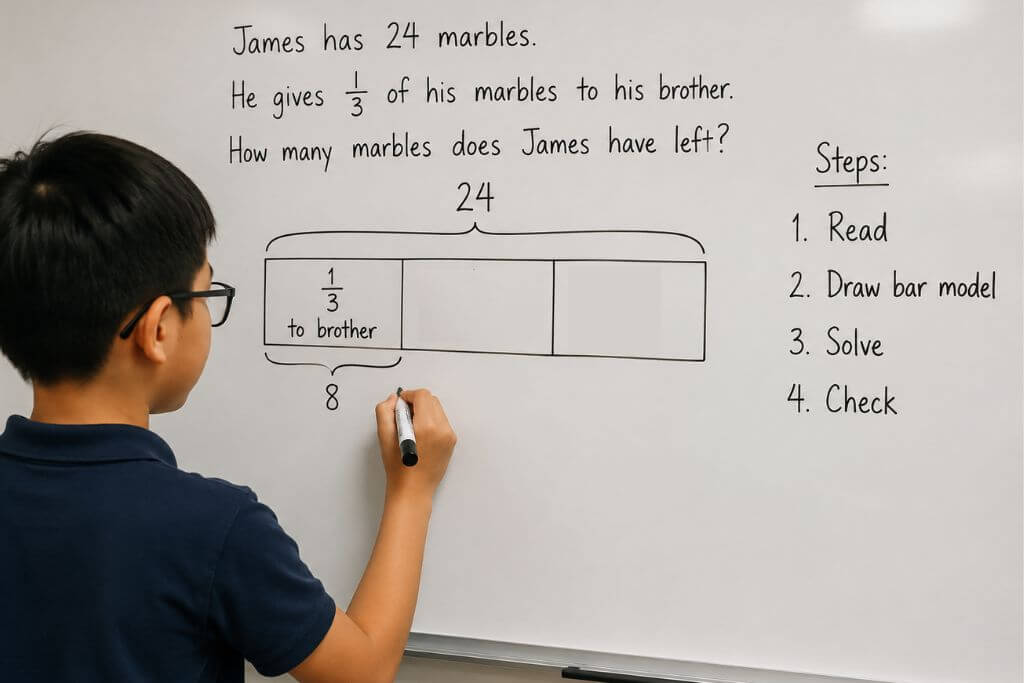
- Read the problem carefully. Understand what’s happening before drawing anything.
- Identify key information. Ask: What is known? What is unknown? What action is being described?
- Draw the bar model. Sketch bars to represent the quantities in the problem.
- Label known values. Include units and brief labels.
- Mark the unknown. Use a question mark (?) to highlight what needs to be solved.
- Write the equation. Translate the bar model into a number sentence or algebraic equation.
Help your child make sense of complex word problems
Join our How to Teach Children the Bar Model Method (On-demand Webinar)
Common Mistakes & How to Avoid Them
1. Not Understanding the Problem Before Drawing
Mistake: Students rush to draw bars without fully understanding what the problem is asking.
Why It Happens: They’re trained to “draw something quickly” and treat the model like a guessing game.
How to Fix It:
- Encourage reading the problem twice.
- Highlight key information: Who? What? How many? What’s the question?
- Teach students to verbalize the situation before grabbing a pencil.
2. Incorrect Bar Proportions
Mistake: Bars are drawn with random lengths that don’t reflect actual relationships.
Why It Happens: Students aren’t thinking proportionally—they’re drawing to “fill space” rather than reflect meaning.
How to Fix It:
- Ask guide questions such as “Which bar should be longer?” and “Why should I draw a longer bar to represent the red marbles?”
- Remind the child to:
- Use consistent units (e.g., 1 square = 1 unit) for equal numbers or equal parts.
- Keep bar lengths relative to each other.
- When estimating, at least maintain visual proportionality (e.g., if one person has 20 more, the bar should be visibly longer).
3. Mislabeling or Leaving Out Labels
Mistake: Bars are either not labeled correctly or completely, making their representations unclear.
Why It Happens: Students assume they’ll remember which bar means what—or don’t know how to label it correctly.
How to Fix It:
- Remind the students to always label:
- Each bar (name or group it represents)
- Known values
- Unknowns with a question mark (?)
- Remind the children to include units of measurement (e.g., apples, dollars, minutes).
- After drawing the model, prompt them to review their bar model and ensure all labels are accurate and complete.
4. Using the Wrong Bar Model
Mistake: Students apply a part-whole model when the problem is actually a comparison—or use a before-and-after model when it’s unnecessary.
Why It Happens: Children sometimes rely only on clue words to choose a model.
How to Fix It:
- Teach students to ask themselves questions like these to determine what model to use:
- Is this problem talking about parts and wholes? → Part-whole model
- Are we comparing quantities in this problem? → Comparison model
- Did something change over time? → Before-and-After
- Provide examples and practice classifying before drawing.
5. Forgetting to Relate the Model Back to the Question
Mistake: Students draw a perfect bar model and solve for something, but not for what the question is actually asking.
Why It Happens: They get caught up in “solving” without confirming what needs to be found.
How to Fix It:
- After solving, re-read the question.
- Check: “Did I solve for what the question is asking?”
- Write a complete sentence answer to ensure the model and solution match the question.
6. Using the Bar Model but Skipping the Equation
Mistake: Some students rely too much on the picture and never translate it into an equation or number sentence.
Why It Happens: They think the model is the solution, not a step toward it.
How to Fix It:
- Teach that the bar models help build the equation—but don’t replace it.
- Practice going from model → equation → solution → answer.
- Remind students to ask themselves after drawing the model: “Can I compute now?”
Tips for Parents and Teachers: How to Teach Bar Modeling Effectively
1. Start with real-life examples
Use concrete objects to build understanding before drawing bars.
2. Teach different bar model types
Give students exposure to various model types and when to use them.
3. Use guided practice
Walk through problems together. Encourage thinking aloud and reflective questioning. Structure the starting session like this:
- Read the problem together
- Discuss what is known and unknown
- Choose the correct model type
- Draw the bar model together
- Solve and write the number sentence
- Reflect: Does the answer make sense?
Want a workbook to go with it? Get the Singapore Math Bar Model Method Book
SHOP YOUR BOOK FROM CENTRAL BOOKS | SHOPEE | LAZADA

- No prior experience needed. The progressive structure means whether they are just beginning their journey in Singapore Math or are already in advanced level, your child can start where they are.
- Parents don’t need to be math experts. Every example, exercise, and chapter test comes with a video walkthrough, so support is always available.
- Flexible for any learning setup. Available in print or e-book.
- Uses the same problem-solving approach taught in Singapore Math classrooms, helping your child build confidence through consistent learning at school and at home.
4. Encourage students to talk through their thinking.
Ask:
- “What does this part of the bar show?”
- “What are we trying to find?”
5. Discuss mistakes openly
Create a safe space for error analysis. It’s one of the best ways to learn.
Frequently Asked Questions (FAQs)
What age is appropriate for the Bar Model Method?
Children as young as 7 can begin with basic part-whole models. The method grows with them through upper elementary and even middle school.
What types of math problems can be solved with bar models?
Bar modeling works well for: basic operations (addition, subtraction, multiplication, division); fractions, ratios, percentages; multi-step and algebraic problems; and word problems of all complexity levels.
Do I need to be good at math to teach this?
Not at all! With step-by-step tools and resources like our e-book and on-demand webinar, both parents and teachers can learn alongside their children.
Can the bar model method be used outside of a Singapore Math curriculum?
Yes. While it is used in Singapore Math, the bar model method is a problem-solving tool that works with any math curriculum. Many teachers use it as a supplement even if their school follows a different program.
Recommended Next Steps
You now know what the bar model method is and how it works. The next step is learning how to actually teach it, clearly and with confidence.
👉 How to Teach Children the Bar Model Method On-Demand Webinar
This is where the method comes to life. Instead of reading about bar models, you’ll watch them being taught in real examples, step by step, at your own pace. Parents can use it to guide a child through tonight’s homework. Teachers can use it to plan how they’ll introduce the method to a class.
Join the parents and teachers already using this method to help their students understand word problems.
Enroll in the How to Teach Children the Bar Model Method Webinar →
👉 Learn How to Teach Children Singapore Math (Webinar)
Bar modeling is one piece of a bigger picture. This webinar covers the full Singapore Math approach, from preschool through Grade 6. It’s a strong next step for anyone new to Singapore Math, and a good refresher for anyone looking to deepen what they already know.

Help children make sense of mathematics.
Join our How to Teach Children Singapore Math (On-demand Webinar)
Final Thoughts: Making Math Make Sense
Remember those furrowed brows and hesitant hands from the start of this guide?
That’s what changes with the bar model method.
Every parent who has watched a child stare blankly at a word problem knows that feeling of helplessness. Every teacher who has tried three different explanations for the same concept knows it too. The bar model method gives children a real starting point: something to draw, look at, and reason through, instead of guessing.
That simple change can make a big difference. When children learn to make sense of a problem instead of feeling intimidated by it, they build confidence with every success—and become more willing to tackle the next challenge.
Not sure where to start?
Every child works through word problems a little differently. If you’d like guidance suited to your child’s needs or your classroom, schedule a free one-on-one consultation. We’ll talk through where your child or students are right now and what would help them most.
Math does not have to be a source of stress at home or in the classroom. With the right tools, it can become something children actually want to work through.
