Why Children Struggle with Word Problems (and How the Bar Model Method Can Help)
If your child can add, subtract, multiply, and divide just fine — but freezes the moment those numbers show up inside a story — you’ve probably asked yourself some version of this:
“My child knows how to add. Why can’t they solve this?”
“We’ve read the question three times. Why is it still confusing?”
“How do I explain this without just giving them the answer?”
If any of that sounds familiar, take a breath. It doesn’t mean your child can’t understand math — it usually just means the strategies they’ve picked up so far (like keyword-hunting) aren’t the ones that actually help.
Here’s the good news: word problems feel hard for a very specific, fixable reason. And once you understand what’s actually going on, there’s a simple visual tool that can make a real difference — the Bar Model Method.
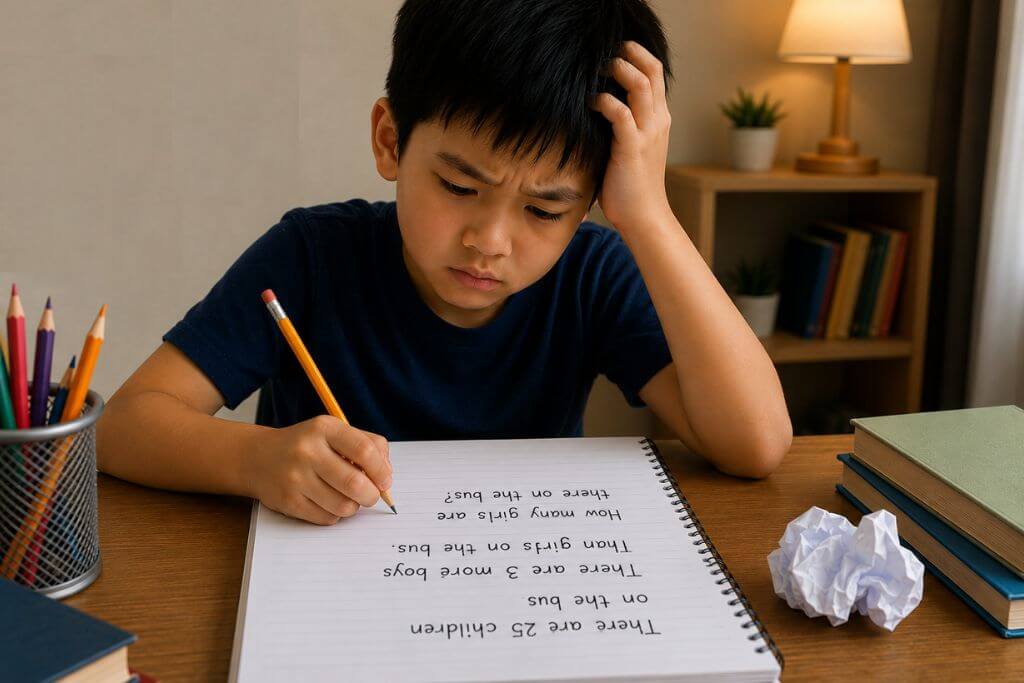
Teaching bar models in the classroom? How to Introduce Bar Models in the Classroom provides step-by-step guidance on helping students learn how to represent word problems using bar models for the very first time.
📖 Read it here.
Why Are Word Problems So Hard in the First Place?
Here’s something worth knowing: solving a word problem actually asks a child to do several things at once. They have to:
- Read and understand what’s happening in the story
- Figure out which details actually matter
- Ignore the ones that don’t
- Decide what operation to use
- Put the information in order
- Actually solve it
That’s a lot to juggle for a young learner — especially one who’s still building reading confidence too. For most children, the hard part isn’t the math itself. It’s figuring out what the problem is even asking.
That’s exactly the gap bar models are built to close — by turning “what is this problem even asking?” into something your child can see on paper.
What Is the Bar Model Method?
It’s a visual problem-solving strategy from Singapore Math. Instead of jumping straight to an equation, children draw simple rectangular bars to represent the quantities in a problem. This helps them see how those quantities relate to each other — which makes the next step much clearer.
Think of it as a picture that holds all the information for your child, so they’re not trying to keep track of everything all at once.
Want to go deeper? I’ve written a full breakdown of how it works here: Singapore Math Bar Model Method: A Complete Guide.
Now let’s look at the most common reasons word problems become difficult for children, and how bar models help with each one.
1. They’re Taught to Hunt for Keywords Instead of Understanding the Story
A lot of children pick up shortcuts along the way, like:
- “Altogether” means add
- “Left” means subtract
- “Each” means multiply
These shortcuts feel helpful at first, but they can quietly work against your child. Instead of thinking through what’s actually happening in the problem, they start scanning for a magic word.
Here’s an example of where that falls apart:
Ella has some stickers. She gives 12 to Max and now has 8 left. How many stickers did Ella have at first?
A child trained to spot keywords will see “left” and immediately subtract. But that’s not what this problem needs — we actually need to add the 12 stickers Ella gave away and the 8 she has left to find out how many she started with.
This is exactly where the Bar Model Method makes the biggest difference. Instead of hunting for a clue word, your child draws the quantities as bars first — Ella’s total, the 12 she gave away, the 8 she kept. Once it’s on paper, the relationship between the numbers becomes visual instead of guesswork.
2. They Can’t Picture What’s Happening
Word problems ask children to build a mental picture before they can even start solving — and keep that picture in view while they figure out what to do with it. That asks a great deal of a child who’s still developing reading stamina.
Without something to look at, the problem can feel like a wall of words rather than a solvable puzzle.
This is where bar models become truly useful. They give your child something to draw, so the numbers aren’t just swirling around unorganized anymore — they’re right there on paper, organized and easy to look at.
📺 Want to see this in action? Watch this short video to see a confusing word problem turn into a clear picture, step by step.
3. They Don’t Know Which Operation to Use
You’ve probably heard your child ask, “Wait, do I add or subtract this one?” This is one of the most common stalling points — and it’s rarely because they don’t know how to add or subtract. It’s because word problems don’t come with a label telling them which operation to use.
Bar models solve this in a simple, effective way: once the quantities are drawn out, the relationship between them becomes visible. Your child isn’t guessing anymore — they’re looking at the picture and reasoning their way to the right operation.
4. Multi-Step Problems Feel Like Too Much at Once
As kids move into the upper elementary grades, word problems get longer. Suddenly there’s more than one thing to solve — maybe they need to find a missing number first, then compare two amounts, then answer the actual question being asked.
It’s no wonder some children get frustrated and quit halfway.
The Bar Model Method breaks this down into something much more manageable. Instead of trying to process the whole problem at once, your child draws out what they already know, figures out what to find first, and works through it one small piece at a time.
🎥 Curious what this looks like with a real multi-step problem? Watch me solve one here.
5. They’ve Stopped Believing They Can Do It
This one matters just as much as the strategy itself. After getting several word problems wrong, many children start telling themselves things like “I’m just not a math person” or “word problems aren’t for me.” Once your child starts believing that, it can affect how they approach every problem after — even ones they’re capable of solving.
The Bar Model Method helps with this too. It gives your child a clear, low-pressure first step: draw what you know. That’s it. No pressure to see the whole solution right away — just one small, doable action to get started. Over time, these small wins slowly bring your child’s confidence back.
A Quick Example of Bar Models in Action
Let’s go back to Ella’s stickers and see what the bar model actually looks like.
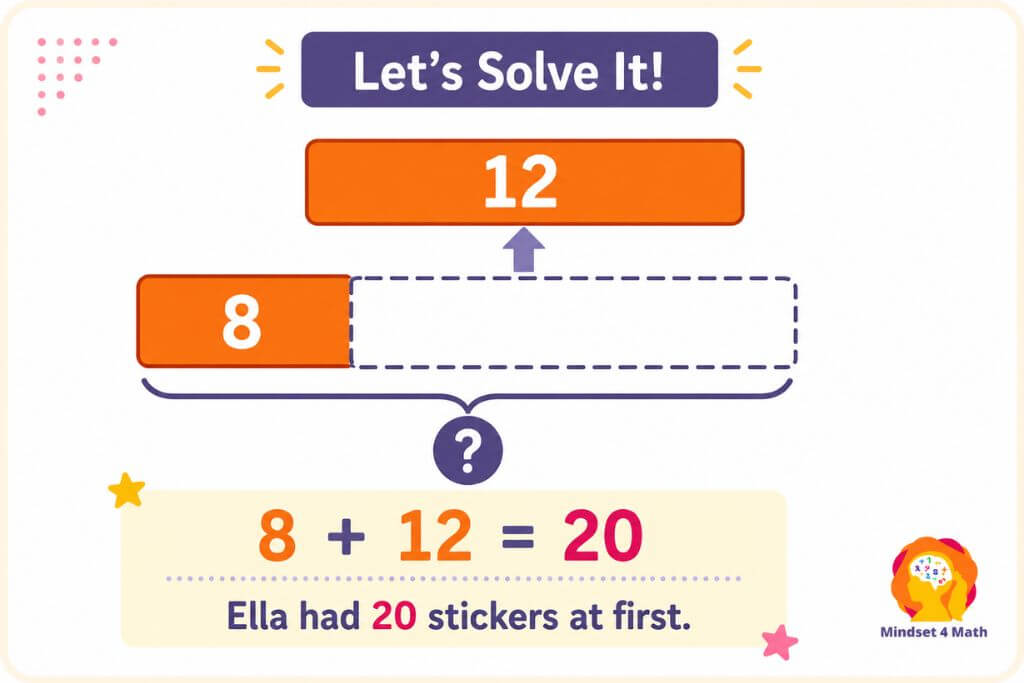
We know that Ella had 8 stickers left when she gave 12 to Max. So we draw a short bar and label it 8, to represent what she has left. Then we add a longer section next to it, made of dashed lines, to represent the stickers she gave away — and we draw an arrow pointing to the taken-away part of the model labeled 12. Together, the 8 and the dashed section make up the whole model, which we mark with a question mark, since that’s what we’re solving for: how many stickers Ella had at first.
Once that’s drawn, the answer becomes visual instead of a guessing game: the two parts together — 12 and 8 — make up the whole model. Add them, and you get 20. That’s how many stickers Ella had at first.
Notice what didn’t happen here: no keyword hunting, no second-guessing. Just a picture that made the relationship obvious.
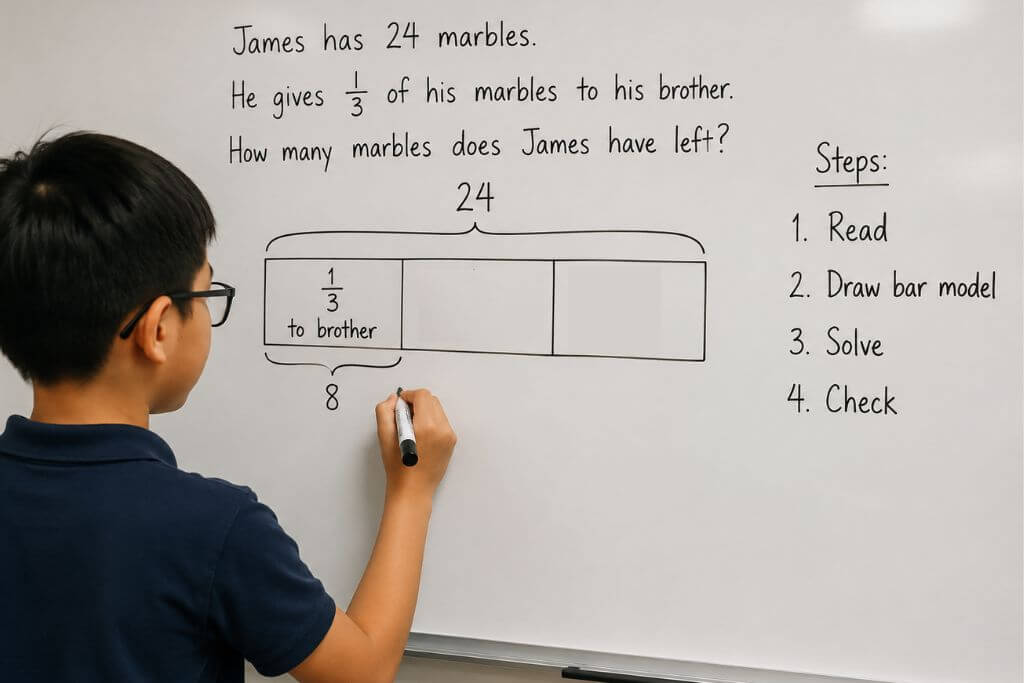
Help your child make sense of complex word problems
Join our How to Teach Children the Bar Model Method (On-demand Webinar)
How You Can Help at Home (Without Needing a Math Degree)
You don’t need to be a math teacher to help your child get better at word problems. A few small shifts in how you support homework time can make a real difference.
1. Understand Before Solving
When your child is stuck on a word problem, resist the urge to jump straight to “okay, so what do we calculate?” Instead, slow down and help them understand the story first.
Try questions like:
- What’s happening in this story?
- What do we already know?
- What is the problem actually asking us to find?
- Who has more? Who has less?
- Can you tell me this problem in your own words?
These questions pull your child’s attention toward meaning, instead of clue-word hunting.
2. Encourage Drawing, Not Perfection
Invite your child to sketch a simple bar model before writing any equation. It doesn’t need to be neat or exact — the goal is just to get the numbers out of their head and onto paper, where the relationships become easier to see.
3. Guide Instead of Rescue
When your child is stuck and frustrated, it’s tempting to just tell them the answer. Try holding back and asking instead:
- What do you already know?
- What are you trying to find?
- How are these two numbers connected?
- Can you show that with a bar model?
This keeps the thinking in your child’s hands, which is exactly what builds independence over time.
4. Practice a Mix of Problems, Not the Same Type Over and Over
Word problems get easier with variety, not repetition. If your child only ever practices one type, they’ll learn to match a pattern instead of actually reasoning through new situations. Varied practice helps children transfer the skill to new and unfamiliar contexts.
Ready to help your child solve word problems with confidence? GET YOUR COPY TODAY.

Shop your physical book from
Get your digital copy here
5. Notice the Effort, Not Just the Right Answer
When your child works through a problem — even if they get it wrong — point out what they did well. A simple comment like “I like how you drew that bar model” or “you really thought that through” can mean more than you’d expect. Small, specific comments like these help rebuild your child’s confidence — more than a correct answer alone ever could.
If you’re not confident drawing bar models yourself yet, that’s completely normal — most parents are learning this for the first time too. That’s exactly why I put together the resources below.
- Join my How to Teach Children the Bar Model Method On-Demand Webinar.
- Check out the Singapore Math Bar Model Method e-book or printed book.
- Sign up for personalized Singapore Math Online Training to support your child’s math journey.
Frequently Asked Questions
At what age can children start learning the Bar Model Method?
Many children start with simple bar models in Grade 2. As they grow, the same tool stretches to handle fractions, ratios, percentages, and even early algebra.
What types of math problems can bar models help with?
Quite a lot, actually — basic operations, fractions, ratios, percentages, multi-step problems, and word problems across most difficulty levels.
Can I learn the Bar Model Method even if I never studied Singapore Math myself?
Does the Bar Model Method only work within a Singapore Math curriculum?
Not at all. It’s a problem-solving tool that works alongside any math curriculum. Plenty of teachers use it as a supplement, even in schools that don’t follow Singapore Math.
Final Thoughts
If your child struggles with word problems, that doesn’t mean they’re bad at math. It usually just means no one has shown them a way to make sense of the information yet.
The Bar Model Method gives your child something concrete to lean on — a way to organize their thinking before they calculate anything at all. Instead of guessing, hunting for keywords, or relying on trial and error, they learn to see the problem, visualize the quantities, and work through it one step at a time. And as that understanding grows, so does their confidence.
You don’t need to have all the answers yourself. By learning the Bar Model Method alongside your child, you can give them exactly the kind of guidance that turns “I don’t get it” into “let me try this.”
If you’re ready to help your child tackle word problems with more confidence, explore my How to Teach the Bar Model Method On-Demand Webinar and the Singapore Math Bar Model Method book — together, they walk you through everything you need to teach this strategy at home. And if you’d like more hands-on, one-on-one support, Mindset 4 Math also offers personalized Singapore Math training built around your child’s specific needs.
